A New Category of Intervention
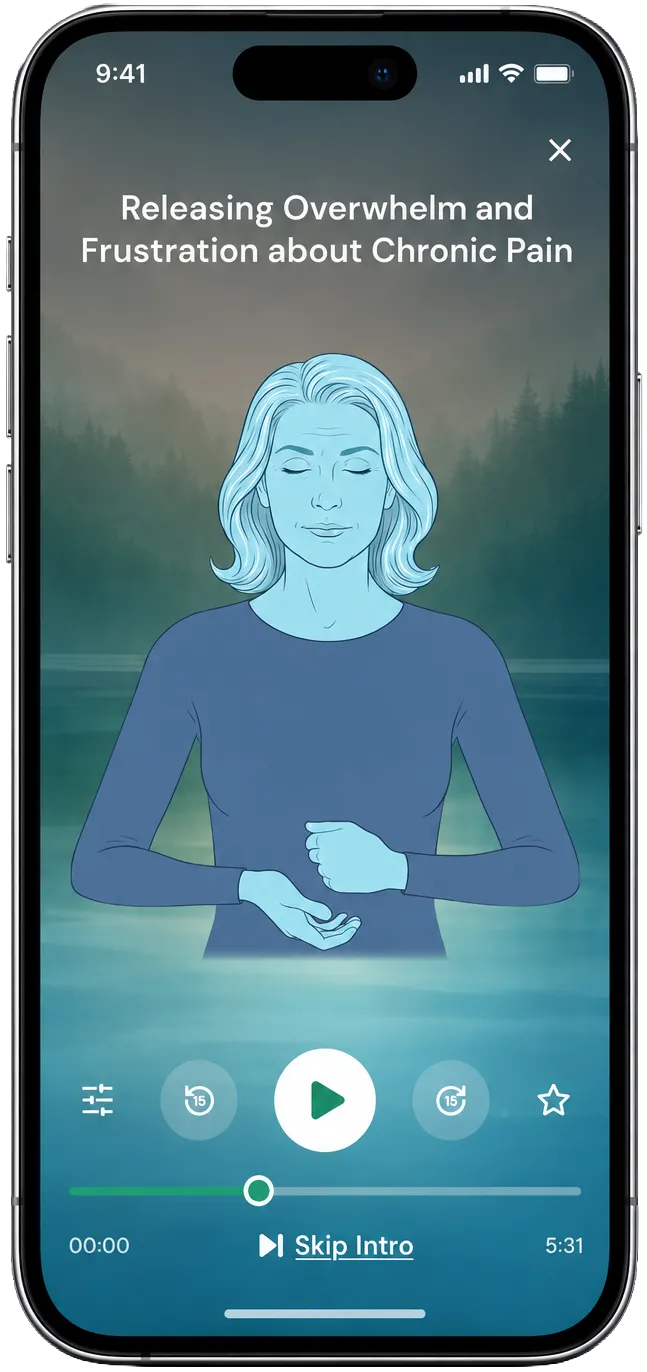
Most digital tools require cognitive engagement—unavailable during acute distress. Our somatic approach works when the thinking brain goes offline, reaching patients at the moment of maximum need. Anxiety, depression, and chronic musculoskeletal pain—delivered to Medicare beneficiaries under the CMS ACCESS Model.
"Like someone turned off the anxiety switch."— Debbie, App member
The Real Problem
Meditation
Builds real resilience
Regular practice rewires the brain. The evidence is solid. But during acute distress—when you're hyperventilating, chest tight, thoughts racing—focusing on breath often amplifies the panic. It's a resilience builder, not a crisis intervention.
CBT Apps
Teach powerful skills
Cognitive restructuring works. It's one of the most evidence-based approaches in psychology. But it requires clear thinking—exactly what's unavailable when the prefrontal cortex goes offline during a panic attack or pain flare.
Mood Trackers
Reveal important patterns
Tracking over time helps you and your therapist spot triggers and trends. That insight is valuable. But at 3am when you're in crisis, logging how you feel doesn't change how you feel.
These tools work—just not in the moment you need help most.
When the thinking brain goes offline, you need a somatic intervention. The body leads, the mind follows. That's where we work—and that's why we complement everything else.
Why Therapists Recommend Us
Therapists see their patients an hour a week—maybe. What happens the other 167 hours?
Clinicians recommend our approach because it gives patients a tool that actually works between sessions—not just tracks symptoms or teaches concepts, but actively regulates the nervous system in real time. We're not replacing care. We're extending it into the moments nothing else can reach.
167
hours per week without your therapist
1 hour of therapy leaves 167 hours where patients are on their own. That's where crisis happens—and that's where we work.
"I work in healthcare. I was so stressed out I couldn't even catch my breath. My mind and heart were pounding. I sat in my car and did that anxiety meditation about 4x and felt such relief. I was shocked."— Healthcare Worker
Two Dimensions of Change
Most interventions do one or the other. We do both—and the data proves it.
Works in the moment of crisis
When the panic attack hits at 2am, when the pain flare wakes you, when the trigger arrives between appointments—we provide immediate nervous system regulation. Not in days or weeks. In minutes.
Rewires the baseline over time
Repeated regulation doesn't just help you feel better now—it rewires your default state. Our structured programs show lasting reductions in anxiety, depression, and stress. Users arrive at Day 5 with meaningfully lower baseline anxiety than Day 1—before any intervention that day.
"I used to be under the grip of constant pain for the last seven years. My overall pain level went from usually 6-8 to an average of 2-3."— Eva, Chronic Pain Relief Program
This is neuroplasticity in action. Each time you move from dysregulated to regulated, you strengthen calmer neural pathways. Over time, the exception becomes the rule.
The Evidence
Nearly two decades of continuous real-world evidence across anxiety, depression, chronic pain, and sleep.
16.6M
Rated sessions analyzed
868,244
Unique users in the cohort
1.21–1.66
Effect sizes (Cohen's d), all eleven domains
62–85%
Sessions with clinically meaningful improvement
Real-world data from The Tapping Solution platform. Manuscript under peer review with MGH and Harvard co-authors; full results held for publication. Explore the evidence →
The JIT-R Framework
During acute distress, the prefrontal cortex goes offline. You can't "think through" a panic attack. Cognitive approaches require exactly what's unavailable in crisis. Our approach is different.
01
Reach people at the moment of maximum need—not before, not after. Traditional models deliver modules on a schedule. We meet people when suffering is happening.
02
The thinking brain is offline during acute distress. The body must lead. Our somatic-first approach bypasses cognition and directly downregulates the nervous system.
03
No appointment. No clinician. No waiting room. Available 24/7. The only intervention that works at 2am is the one you can access at 2am.
04
Consistent state change rewires the default trait. Each use strengthens calmer neural pathways, making regulated states the new baseline over time.
The Intervention
Evidence-based EFT (Emotional Freedom Techniques) delivered through guided audio sessions. Users tap on acupressure points while speaking the feeling out loud—naming and acknowledging what's actually there, guided word by word, rather than tapping in silence. Pairing somatic stimulation with spoken emotional processing is the technique's active ingredient—and it downregulates the nervous system in minutes.
Why Now
Mental health needs have surged while provider capacity remains flat. The gap between demand and supply has never been wider—or more urgent to fill.
CMS and commercial payers are aggressively pursuing behavioral health integration—the ACCESS Model itself is the proof. What gets covered is what can demonstrate outcomes, not just engagement.
The Tapping Solution—our consumer platform, and the dataset NeuroTap is built on—has run for nearly 20 years. The 16.6 million rated sessions we analyzed make the evidence base no longer a promising signal. It's a dataset large enough to act on.
Digital mental health is crowded with tools that teach skills for later. Almost nothing is built for the moment itself—the thing a patient reaches for when the thinking brain is offline. That unmet need is where we work.
Two Clinical Tracks. One Mechanism.
Anxiety and chronic pain share a common root: autonomic nervous system dysregulation. Our somatic approach addresses both through the same mechanism—opening two distinct market opportunities.
Anxiety & Depression
d = 1.44
Anxiety, our within-session data
g = 1.27
Depression, 18 published RCTs
Musculoskeletal (MSK) & Chronic Pain Management
d = 1.21
Pain, our within-session data
6 mo
RCT gains held at follow-up
Why one intervention works for both: Both conditions involve autonomic dysregulation—the same overactive stress response. By calming the nervous system during activation, we address the shared root mechanism.
Complementary by Design
We're not replacing CBT apps or meditation—we're the layer that makes everything else work better.
Best for skill building
d = 0.3–0.5
Typical effect size
Teaches powerful cognitive techniques. Requires clear thinking to apply—challenging during acute distress.
Best for the acute moment + lasting change
d = 1.21–1.66
Effect size
Works during acute distress when cognition is offline. Somatic-first approach bypasses the thinking brain entirely.
Best for resilience building
d = 0.2–0.4
Typical effect size
Builds long-term calm and awareness. Requires baseline regulation to practice effectively.
The best outcomes come from multiple tools working together. We reduce baseline distress so CBT homework is achievable. We calm the nervous system so meditation practice is accessible.
Leadership
Guided by leaders in psychiatry, neuroscience, and digital health.
Nick Ortner
Founder & CEO
Founder of The Tapping Solution. Nearly 20 years pioneering evidence-based EFT delivery at scale.
Tony Robbins
Strategic Advisor
Bestselling author, entrepreneur, and philanthropist.
Scientific Advisory Board
Dr. Maurizio Fava
Chair, Scientific Advisory Board
Chair of Psychiatry, Mass General Brigham. Slater Family Professor of Psychiatry, Harvard Medical School.
Dr. Mark Rapaport
Scientific Advisory Board
President, American Psychiatric Association (2026–2027). Founding CEO, Emeritus, Huntsman Mental Health Institute.
Dr. Helen Lavretsky
Scientific Advisory Board
Professor of Psychiatry, UCLA. Expert in integrative mental health and aging.
For Payers & Health Systems
The 2am crisis that becomes an ED visit. The caregiver who burns out and hands the system a patient. We prevent escalation at a fraction of the cost—and we have the data to prove it.
Learn More$2,264
Cost of boarding one psychiatric patient in the ED
63M
Americans serving as family caregivers
167
Hours a week without a therapist
24/7
Availability, zero wait time
Get in Touch
We're partnering with health systems, payers, and researchers committed to filling the gaps in mental health care.
Contact Us