A guided program for adults living with anxiety, depression, or chronic pain.
Built on EFT Tapping — a researched technique that pairs gentle tapping with guided words, designed to help your body settle.
Enrollment is open — delivered through a simple app, at $0 out of pocket for eligible adults with Original Medicare, nationwide.
Pick the option that fits, and we'll take you to the right place.
NeuroTap is $0 out of pocket with Original Medicare. Check your coverage and enroll online.
Check my coverage →Set it up for a parent, spouse, or friend who's on Original Medicare.
Start for them →Not on Original Medicare? Tell us your plan and we'll work to bring NeuroTap to you. Not sure which you have? We'll help you check.
Get on the list →Offer NeuroTap to your eligible patients — at no cost to them.
Refer patients →NeuroTap is available to eligible adults with Original Medicare, anywhere in the US, at $0 out of pocket for the program. We don't collect the Medicare coinsurance — no subscription, no copay, no hidden costs. (Healthcare you receive outside the program is billed under your normal Medicare rules.)
Tell us whether it's for you, someone you love, or your patients — using the options above.
During enrollment, we confirm Original Medicare coverage and a brief screening confirms the program is a fit. Nothing for you to figure out.
If you qualify, begin your guided Tapping sessions at $0 out of pocket, supported step by step. No tech experience needed.
Take a look at your Medicare card. If it's the red, white, and blue card that says "Medicare Health Insurance," you have Original Medicare — the coverage NeuroTap is open to now, at $0 out of pocket for those who qualify. If your card shows a company name like Humana, UnitedHealthcare, or Aetna, you likely have Medicare Advantage, which the program doesn't yet include — choose "I'm on Medicare Advantage or another plan" above and we'll tell you the moment there's a path for you.
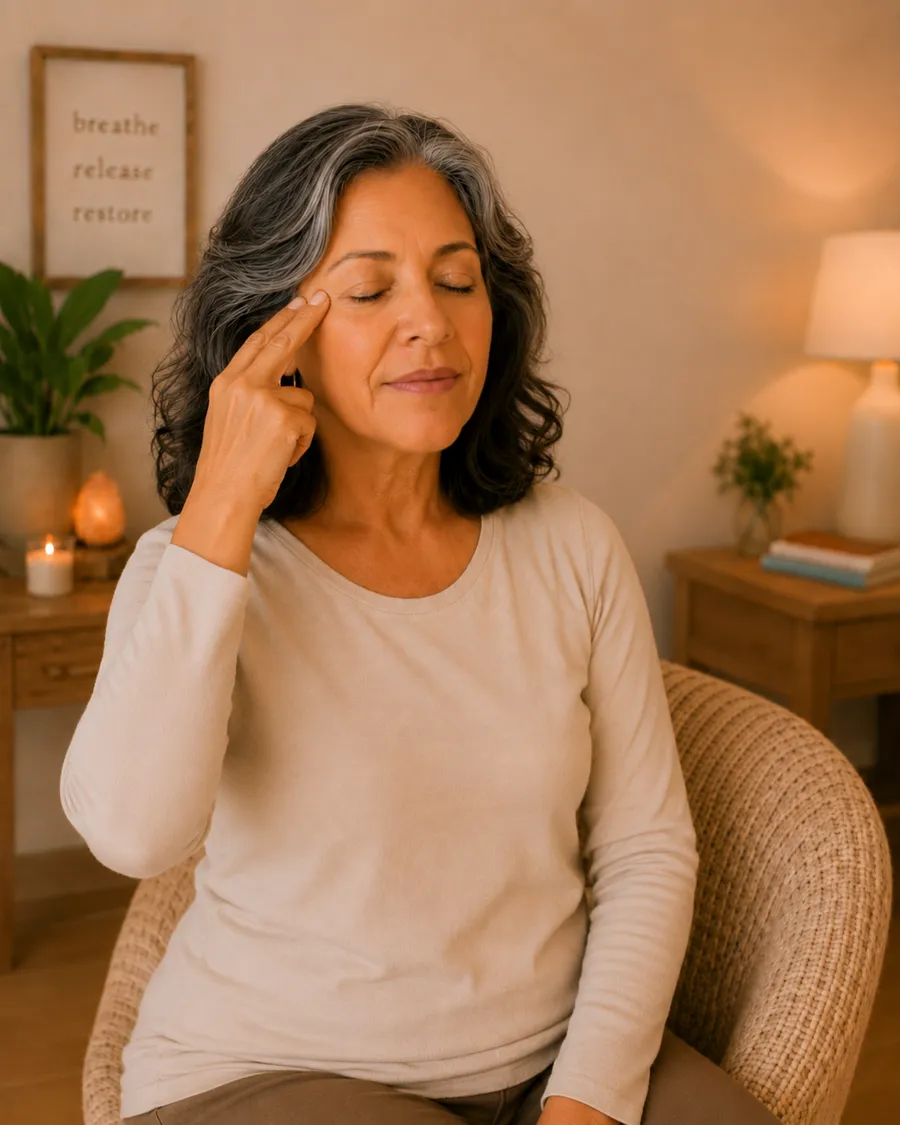
Guided audio sessions in a set order — usually 5 to 20 minutes a day, one step at a time — delivered through the NeuroTap app on your smartphone or tablet, so it's with you the moment you need it. Check your Original Medicare coverage online, then begin the program in the app.
Check my coverageAvailable on the App Store and Google Play.
Fair question. NeuroTap participates in a Medicare program called the ACCESS Model, which pays for this kind of care for eligible adults. And we've chosen not to collect the Medicare coinsurance — so for eligible participants, there's nothing to pay for the program itself.
Tapping (clinically, EFT — Emotional Freedom Techniques) uses light fingertip pressure on specific points on the face and hands. Those points sit over dense clusters of mechanoreceptors — the body's touch and pressure sensors. Tapping them sends signals to the brain while you focus on what's troubling you. Researchers propose that this helps quiet the brain's threat response. NeuroTap turns this into a guided, structured program that builds session by session.
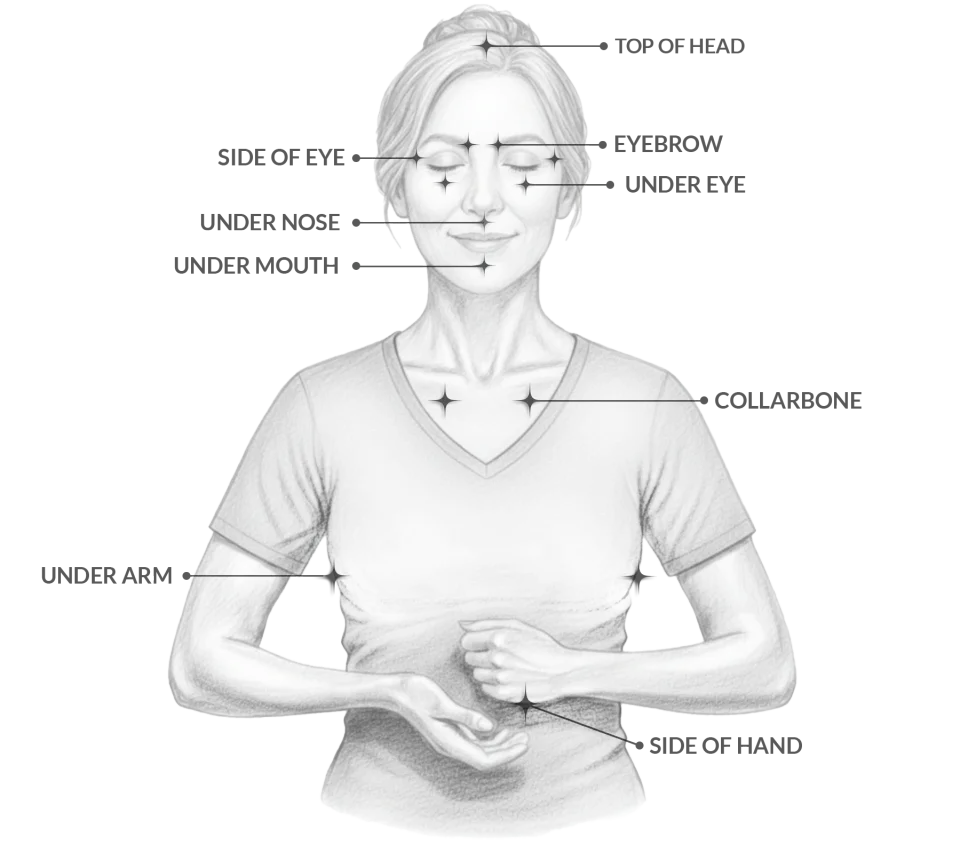
When you're stressed, your brain's threat center — the amygdala — sounds an alarm, and your thinking brain goes quiet. Researchers have proposed how Tapping may quiet that alarm. Here is the proposed pathway:
Tapping stimulates mechanoreceptors — touch sensors clustered at these points — generating signals that travel to the brain. The proposal is that these signals help the stress alarm quiet down.
The idea is that the body moves out of fight-or-flight toward rest. In one randomized study, cortisol — the stress hormone — fell 43% after an hour of Tapping, against 19% after an hour of talk-based education.
Researchers propose that, through memory reconsolidation, the old stress association is updated rather than just held down. Small brain-imaging studies report calmer activity in regions a stressor lights up.
In some studies on anxiety and depression, the benefits of Tapping were still present at follow-up.
Sources: Feinstein, Frontiers in Psychology (2025); Stapleton et al., 2020 (cortisol); Chatwin et al. (2016); Stapleton et al. (2016).
Through Medicare's ACCESS Model, NeuroTap supports adults living with anxiety, depression, and chronic muscle and joint pain — the areas where EFT has the deepest evidence and the greatest need. A brief screening at enrollment confirms the program fits your needs.
Guided support to calm the body's stress response and quiet persistent worry.
Learn more →Gentle, structured sessions that support mood — one day at a time.
Learn more →Support for the stress and tension that can amplify the experience of ongoing back, neck, and joint pain.
Learn more →NeuroTap isn't a tap-once-and-you're-done app. It's a supported program that builds over a series of sessions — designed so the calm you feel in the moment can become steadier over time.

A warm welcome and your first guided session. Nothing to set up — just press play and follow along.
Short guided Tapping sessions — usually 5 to 20 minutes — that you do on your own schedule, building week by week.
You can rate how you feel before and after each session, so you and your care team can see the change over time — not just take our word for it.
Once it's part of your routine, NeuroTap is there whenever a wave of worry, low mood, or pain hits — on the phone already in your pocket.
Tapping's clinical name is EFT — Emotional Freedom Techniques — and it's among the most-studied techniques of its kind, with more than 300 research studies, including randomized controlled trials and meta-analyses across anxiety, depression, and pain. Every study is cataloged — criticisms and null results included — in our public research library: browse the full research library →
drop in cortisol — the body's primary stress hormone — after one hour of EFT, versus 19% for an hour of talk-based education (randomized study — Stapleton et al., 2020).
research studies and reviews on EFT. In some studies, effects on anxiety and depression were still present at follow-up.
of published research behind Tapping (EFT) for anxiety, mood, and pain.

Chair of Psychiatry, Mass General Brigham; Slater Family Professor of Psychiatry, Harvard Medical School. A world leader in mood disorders, with 900+ peer-reviewed articles cited more than 100,000 times.

President of the American Psychiatric Association (2026–2027); Founding CEO Emeritus of the Huntsman Mental Health Institute. A nationally recognized leader in mood-disorder and mind-body intervention research.

Professor of Psychiatry, UCLA; Director, Late-Life Mood, Stress, and Wellness Research Program. A leading researcher in integrative and geriatric mental health.

A board-certified physician and researcher who authored a landmark 2016 meta-analysis on Tapping (EFT) for anxiety. She provides clinical oversight of NeuroTap's programs and patient-safety standards.
"It's rare to find a technique that is both extremely accessible and effective. It's why I recommend that both my patients and students learn Tapping."
Real, anonymized feedback from people using the Tapping programs NeuroTap is built on.
"I discovered the source of decades of unexplained anxiety and felt a burden had been lifted."
"I felt calmer and mentally and physically lighter after. My body has taken a breath and lost a lot of tension. My shoulders have dropped and my back pain has eased. I have also more energy."
"Much more calm and centered. Far less scattered and anxious. More me."
"It is definitely worth the 10-15 minutes per day."
"My experience was life-changing on a scale I found hard to believe."
"Over the course of this program, I noticed a decrease in my anxiety and felt peace and calm most days."
Individual experiences from people using these Tapping programs. Results vary from person to person.
A technique where you tap on your face with your fingertips — and someone tells you it can help with worry or pain you've carried for forty years. I'd be skeptical too. I was, twenty years ago. Then I watched it work — on my own stress, and on people I love. I ended up maxing out my credit cards to film a documentary about it, because I needed to show people what I'd seen.
Twenty years later, nobody has to take my word for it. Tapping — EFT, clinically — now has more than 300 research studies, including a randomized study in which cortisol, the body's stress hormone, fell 43% after an hour of Tapping. And through The Tapping Solution app, we measured it at a scale no one had before: more than 16 million times, people have told us how they felt before a session — and how they felt after.
But the messages that stay with me come from the people who found it late. One of the first people through the NeuroTap program said it better than I could: "Sad at how long I didn't know this — 70 years."
NeuroTap exists for exactly those people — and it's built to the standards of medicine: a scientific advisory board chaired by the Chair of Psychiatry for Mass General Brigham, outcomes measured at every session, and participation in Medicare's ACCESS Model so cost is never the reason someone doesn't try.
If that's you, or someone you love: you've waited long enough. I hope you'll let us show you what I saw twenty years ago.

"I don't just endorse this work from the sidelines. I use it myself. I've tapped before massive events. I've tapped in my personal life. I've tapped when I needed to shift my state fast. It's part of my own toolkit, right alongside the methods I've taught for decades."
NeuroTap participates in Medicare's ACCESS Model — eligible patients with anxiety, depression, or chronic pain pay nothing out of pocket. Visit NeuroTap Health for the clinical framework, the evidence base, and referral information for your patients.
 NeuroTap