A guided Tapping program for adults living with depression.
NeuroTap is a guided Tapping program offering steady, gentle support for low mood — short sessions that help you feel a little safer and a little lighter, one day at a time. Built on a technique with decades of research, and $0 out of pocket for eligible adults with Original Medicare.

Depression can make everything feel like too much — getting up, reaching out, believing things can shift. NeuroTap meets you gently, with short guided sessions that help your body feel a little safer, so the heaviness has room to ease.
Low mood often comes with a nervous system stuck in shutdown or high alert. Tapping offers a gentle, physical way back toward feeling safe.
Low mood can leave the body stuck on edge. Tapping — light fingertip taps on specific points on your face and hands — is designed to send a steadying signal, something hard to think your way into.
Depression and chronic stress are deeply linked. In one randomized study, cortisol — the stress hormone — fell 43% after an hour of Tapping.
Tapping while you focus on what's heavy helps emotions surface and soften — grief, worry, self-criticism — without becoming overwhelming.
The program is built on regular practice. In some published studies, benefits were still present at follow-up.
Tapping (clinically, EFT — Emotional Freedom Techniques) uses light fingertip pressure on specific points on the face and hands. Those points sit over dense clusters of mechanoreceptors — the body's touch and pressure sensors. Tapping them sends signals to the brain while you focus on what's troubling you. Researchers propose that this helps quiet the brain's threat response. NeuroTap turns this into a guided, structured program that builds session by session.
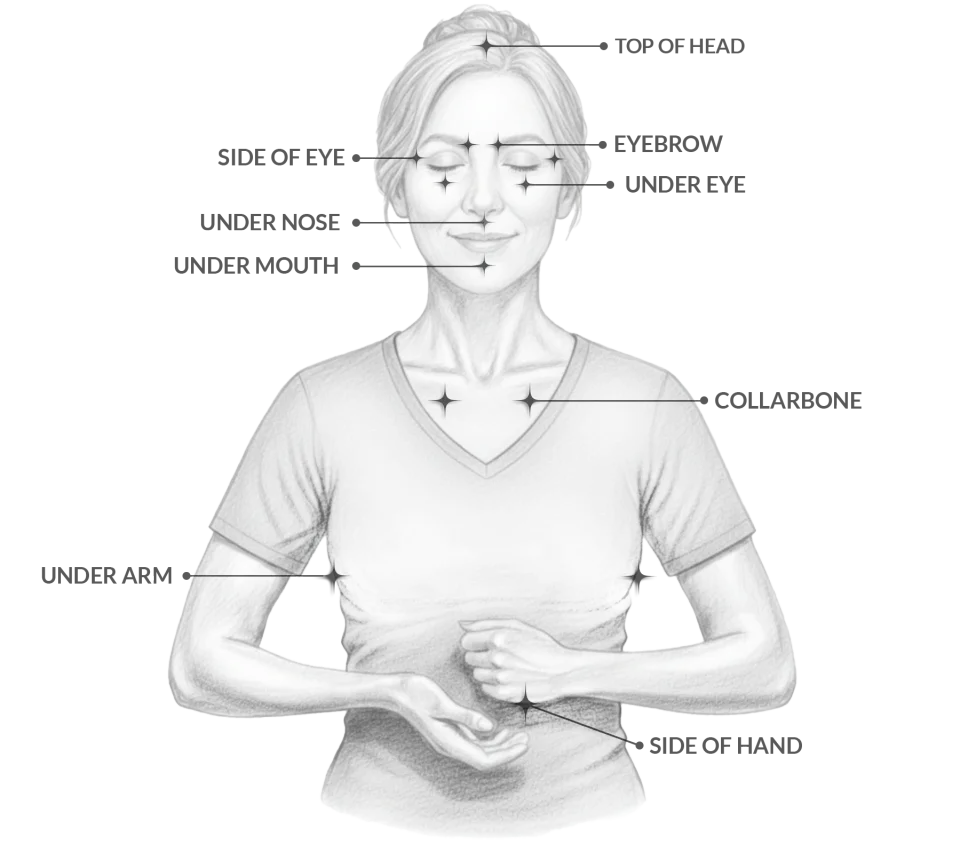
Tapping's clinical name is EFT — Emotional Freedom Techniques — among the most-studied techniques of its kind for mood. In some studies, benefits were still present at follow-up.
research studies on EFT, including randomized trials and meta-analyses.
In two published studies, EFT benefits for depression were still present at follow-up.
of published research behind Tapping (EFT) for mood.
Sources: Chatwin et al. (2016) and Stapleton et al. (2016) on durability of EFT for depression; Stapleton et al., 2020 (cortisol); Feinstein, Frontiers in Psychology (mechanism).
Guided by a scientific advisory board of leading psychiatrists from Harvard, Mass General, and UCLA — including the sitting President of the American Psychiatric Association.
Real, anonymized feedback from people using the Tapping programs NeuroTap is built on.
"My experience was life-changing on a scale I found hard to believe."
"I felt calmer and mentally and physically lighter after. My body has taken a breath and lost a lot of tension. My shoulders have dropped and my back pain has eased. I have also more energy."
"Much more calm and centered. More me."
"It is definitely worth the 10-15 minutes per day."
"I feel excited about life again!"
"I felt guided, accompanied, and understood at all times. I felt a great sense of relief. Now I know I have a tool that can help me at any time."
Individual experiences from people using these Tapping programs. Results vary from person to person.
If you or a family member has Original Medicare and is living with low mood or depression, the program is $0 out of pocket — we don't collect the Medicare coinsurance. No subscription, no copay, no hidden costs.
Take a look at your Medicare card. If it's the red, white, and blue card that says "Medicare Health Insurance," you have Original Medicare — the coverage NeuroTap is open to now, at $0 out of pocket for those who qualify. If your card shows a company name like Humana, UnitedHealthcare, or Aetna, you likely have Medicare Advantage, which the program doesn't yet include — join the list anyway, and we'll tell you the moment there's a path for you.
 NeuroTap